What Is a Junior 4 Apartment in NYC?
Back to the NYC Real Estate Blog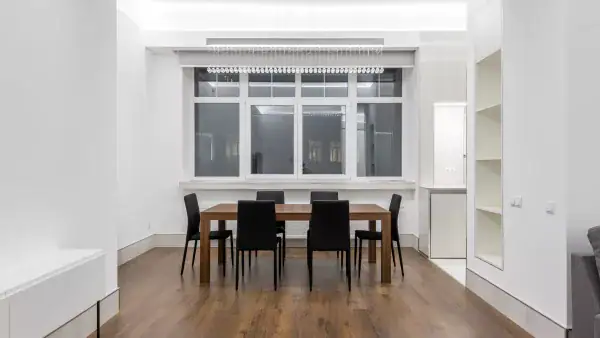
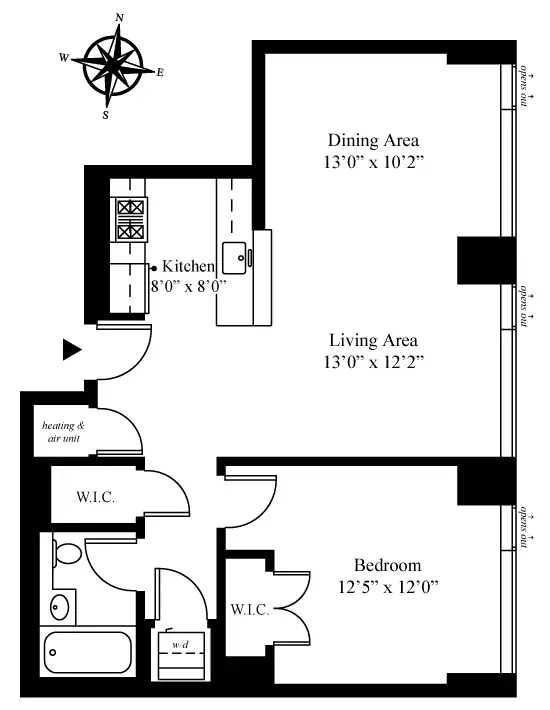
A junior 4 is a one bedroom apartment with a fourth room: bedroom, kitchen, living room, plus an alcove or small dining space. There’s no legal definition of the term. Whether that fourth room counts as a second bedroom is decided by the building code, not by the listing.
We buy and sell these constantly. The junior 4 is where the gap between what a listing says and what the tape measure says is widest.
Why it’s called a four when it has one bedroom
New York counts rooms, not bedrooms, which is the sort of thing you learn on your fourth viewing and wish you’d known on your first. A standard one bedroom is three rooms. Add a fourth and somebody has a junior 4 to sell you.
The “junior” is doing real work there. It signals the fourth room isn’t a full one: an alcove, a nook, or a space carved off the living room. Whether it clears the code is worth settling before the offer, not after.
Nobody has ever agreed on any of it, and nobody has ever been asked to. Aaron Seawood of Compass gives the working definition: “A junior 4 – or ‘JR4’ – is a one-bedroom apartment with a separate dining alcove that can also be used as an office nook or separate bedroom when formally divided.” No statute says so. It stuck anyway.
| Layout | Rooms | Bedrooms | The fourth room |
|---|---|---|---|
| One bedroom | 3 | 1 | none |
| Junior 4 | 4 | 1 | alcove, nook or small dining space |
| Classic 4 | 4 | 1 | a full dining room, usually with a window |
| Two bedroom | 4 | 2 | a legal second bedroom |
The middle two rows look identical on a listing site and are not the same apartment. A classic 4 has a proper room; a junior 4 has the idea of one.
Can the fourth room become a second bedroom?
Three things have to be true, and all three are in the code. This is the test worth running before you bid, because it decides whether you’re buying a one bedroom or a two.
| The test | The number | Where it comes from |
|---|---|---|
| Floor area | 80 sq ft, no dimension under 8 ft | Admin Code §27-2074 |
| Ceiling | 8 ft | same section |
| Window | 12 sq ft, and a tenth of the floor area, onto a street, yard or court | §27-2058 |
One caveat on that last row: §27-2058 governs buildings put up after 18 April 1929, and an older one runs under different sections. Most co-ops with junior 4s are prewar, so this matters more often than it sounds. Both versions are in our legal bedroom guide.
The window is where most junior 4s quietly fail, and it’s the one item on the list that cannot be bought. The fourth room is usually carved out of the interior, so it has no exterior wall.
No contractor, however good, can put a window in a wall that faces the hallway. Everything else on the list is buildable. That one cannot, and it’s the difference between a one bedroom and a two bedroom price, which is what we settle before the offer.
Take the tape measure to a viewing, or bring somebody who is paid to represent you rather than the seller. It takes thirty seconds and it settles a six-figure question.
Should a junior 4 be listed as a two bedroom?
This is the argument that makes junior 4s controversial, and both sides have a point.
Listing it as a two bedroom puts the apartment in front of far more buyers, and if the fourth room passes the test above, it genuinely is one. Listing it as a one bedroom is honest and loses a large slice of the audience.
Most brokers land in the middle: a one bedroom described as convertible, with the fourth room shown and measured. That’s defensible in a way “two bedroom” often isn’t when somebody arrives with a ruler.
An agent has said the quiet part out loud. Nichole Thompson-Adams of Corcoran, on rooms sold as second bedrooms: “A lot of these may have the window, but not a closet, or vice versa.” She warns they get marketed as two bedrooms and shouldn’t count as one at resale.
The motive isn’t a mystery. From a forum thread on exactly this question: “I would say definitely list as a 2 bedroom… our streeteasy search does not look for 1 bedrooms.”
| What the listing is doing | Why |
|---|---|
| “Two bedroom” | Puts the apartment in a search that excludes one bedrooms |
| “Convertible” | Honest, and costs the seller part of the audience |
| “Junior 4” | Accurate, and the smallest audience of the three |
And here’s the part that should change how you read a listing. A long-standing poster on that thread pointed at the standard contract: “there’s a standard clause in the Blumberg form contract talking about how the buyer has not relied on ‘Real Estate Broker’s set-ups’.”
That clause is in the contract you sign. The listing description isn’t something you can rely on later, which makes measuring it yourself the only version that counts.

Where it gets expensive is at resale. Pay a two bedroom price for a room that never qualified, and the next buyer’s agent finds it. The correction lands on you.
Where you find them, and why they’re getting rarer
Junior 4s are mostly a co-op phenomenon, and mostly prewar and early postwar.
New condo developers rarely build them, for the least mysterious reason in real estate: if the space is big enough to be a bedroom, they build a bedroom and charge for it.
Meanwhile owners convert the ones that can be converted. What stays on the market drifts towards the fourth rooms that will never make it, which is worth knowing before you assume the one in front of you is a bargain.
What we see in the field
Two things come up in nearly every junior 4 viewing.
The wall is already there and nobody has permission for it. Plenty of junior 4s have been informally converted with a pressurised wall. Usually fine to live with, but it’s a question for the board and your attorney at contract.
The alcove is 60-something square feet. Close enough to look convertible, far enough that it never will be. That gap is what our guide to legal bedroom requirements exists for, and it’s the same question governing an alcove studio one category below.
| What you’re told | What to check | What it usually means |
|---|---|---|
| “Easily converted” | Does the fourth room have an exterior wall | No wall, no window, no conversion |
| “Second bedroom” | Floor area against 80 sq ft | Often 60-something, and that is final |
| “Wall comes with it” | Board approval on file | Fine to live with, a question at contract |
| “Classic 4” | Whether the fourth room is full-size | A different, better apartment than a junior 4 |
Nobody needs a specialist for this. They need somebody in the room who gets paid to be on their side and has done it before, with a tape measure.
Common questions
Is a junior 4 the same as a convertible one bedroom? Nearly. Convertible describes the possibility, junior 4 describes the room count. The same three-part test decides whether the conversion is real.
Is a junior 4 bigger than a one bedroom? Usually, and priced accordingly. How much bigger varies so much by building that any average would mislead you.
Can I put a wall up myself? You’ll need the building’s permission for anything fixed, and boards differ wildly. Free-standing dividers that stop short of the ceiling are furniture.
Is a junior 4 the same as a classic six? No, and not close. A classic six has six rooms and two full bedrooms plus a staff room. It’s two whole categories up.
Does a junior 4 hold its value? It sits between a one bedroom and a two bedroom on the way in and on the way out, which is exactly what you’d expect. The risk isn’t the layout, it’s paying two bedroom money for it.
The measurement that decides the price
A junior 4 is a good apartment and a bad thing to guess at. The difference between its two versions is 80 square feet and a window, and both are knowable before you make an offer.
We measure it for every buyer we represent, and hand back up to 2% at closing. See how the buyer rebate works, or the full guide to NYC apartment types.



Nicole Fishman Benoliel co-founded NestApple in 2017. She's a lawyer admitted to the New York bar - her law degree is from La Escuela Libre de Derecho in Costa Rica, with further study at IE Business School in Madrid and an LLM from Fordham in New York. She does not act in a legal capacity at NestApple; every client is referred to an attorney who handles real estate deals full time.