Legal Bedroom Requirements in NYC
Back to the NYC Real Estate Blog
A legal bedroom in a New York City apartment built after April 1929 needs 80 square feet of floor area, no dimension under 8 feet, an 8-foot ceiling, and a window of at least 12 square feet facing a street, yard, or court. Miss one of those, and it isn’t a bedroom, whatever the listing says.
We’ve bought and sold apartments here since 2017 and returned over $11 million to buyers, and the gap between a listed bedroom and a legal one is the single most common thing we measure on a first viewing.
NYC is stricter than the rest of the country, and nobody mentions it
Search this question, and you’ll get the national numbers. That’s the International Residential Code, which most states adopt more or less intact. New York City doesn’t use it for apartments. It uses its own Housing Maintenance Code, and the numbers are bigger.
| Most of the country (IRC) | New York City | |
|---|---|---|
| Floor area | 70 sq ft | 80 sq ft |
| Smallest dimension | 7 ft | 8 ft |
| Ceiling height | 7 ft | 8 ft |
| Window | Egress opening required | 12 sq ft minimum, and at least 1/10 of the floor area |
| Closet | Not required | Not required |
Ten square feet doesn’t sound like much until you’re standing in the room. It’s the difference between a bedroom and a study, and in this market, that difference has a price on it.
The New York figures come from Admin Code 27-2074 for size and height, and 27-2058 for windows.
Legal bedroom size: where the 80 square feet comes from
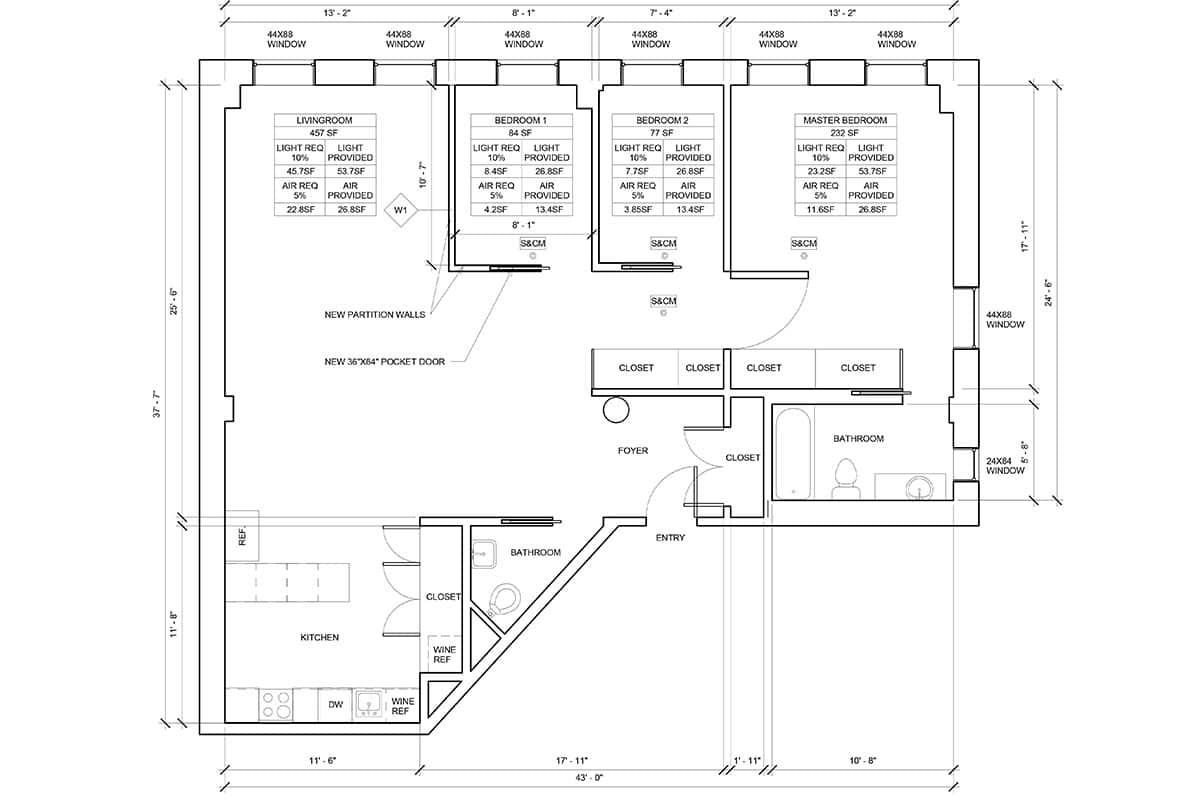
The code doesn’t use the word bedroom. It says living room, which covers every room people actually live in, and it sets two floors. In a multi-dwelling built after 18 April 1929, one living room must be at least 150 square feet, and every other living room must be at least 80 square feet, with no dimension under 8 feet.
So the 150 is your living room, and the 80 is each bedroom. There’s a reason so many prewar layouts have one generous room and several tight ones, and it isn’t taste.
Two exceptions are worth knowing. In an apartment with three or more bedrooms, half of them may have a minimum dimension of 7 feet rather than 8 feet. And a converted dwelling, meaning an older building converted to apartments rather than built as such, works to 60 square feet and 550 cubic feet of air instead.
An 8-by-8 room is 64 square feet. It clears the dimension and misses the area by a fifth, which is exactly the arithmetic that put two different numbers on this site until we rewrote it.
Is a bedroom without a window legal in New York?
No, and the window rule is stricter than the one number everyone quotes. A required window must be at least 12 square feet and at least one-tenth of the room’s floor area. The second half is the one that catches people.
Run it: a 120-square-foot bedroom needs 12 square feet of window, so the two rules agree. A 200-square-foot bedroom needs 20. The bigger the room, the more glass it owes you.
The window also has to open onto something real. The code names a street, a lawful yard, or a court on the same lot, and it rules out a recess narrower than 6 feet. A window onto an airshaft that fails that test doesn’t count, which is why some loft conversions have rooms that will never be bedrooms no matter what gets built inside them.
Does a bedroom need a closet in New York?
No. There is no closet requirement anywhere in the code. Not in New York, not in the IRC, not anywhere we’ve been able to find it.
Agents say otherwise with tremendous confidence, and most of them believe it. It’s a market convention that was promoted to a rule sometime in the 1970s, and nobody has been willing to demote it since. If a room meets the area, dimension, height, and window requirements, it’s a bedroom with a wardrobe.
What about a basement bedroom?
This is where New York gets specific in a way the national code doesn’t. A living room on a top story may drop to 7 feet in any part more than 6 feet from the front wall, which is the sloped-ceiling allowance. Below grade, the rules tighten rather than loosen: cellars are generally off limits for living space, and basements have their own conditions on light, air and egress.
If you’re being shown a finished basement room as a bedroom, that’s the moment to ask for the certificate of occupancy rather than the floor plan.
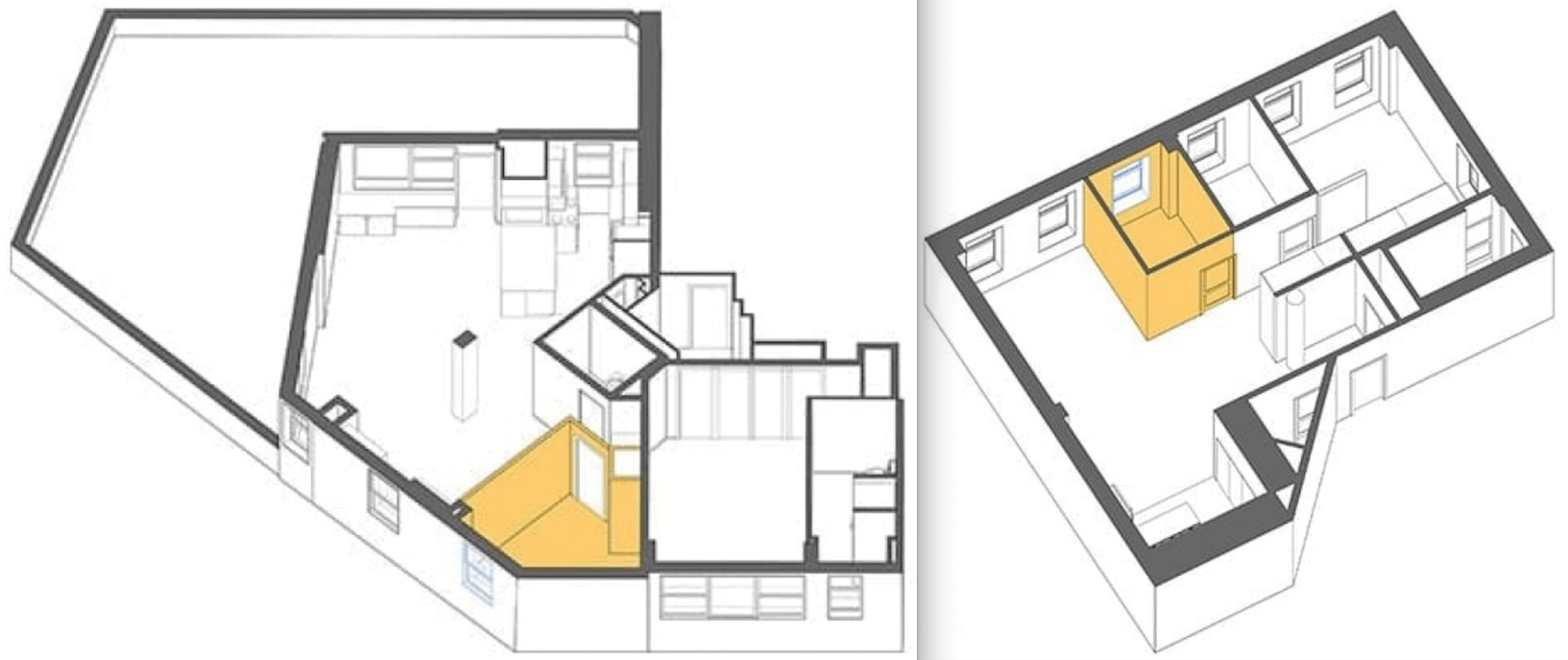
Those two plans are the whole argument in one picture. Both add a room. Only the left one adds a bedroom because it reaches a wall with a window. No amount of drywall fixes the right-hand case.
What we see in the field
Two patterns, both expensive, both easy to check.
The fourth room that isn’t a bedroom. A junior 4 is a one-bedroom with an extra room, and whether that extra room is legally a bedroom is the whole question behind the price. Same for the recess in an alcove studio, which typically runs 40 to 48 square feet and therefore never qualifies.
The maid’s room in a prewar layout. The staff room in a classic six is frequently under 80 square feet, which is why a classic six is sold as three bedrooms and lives like two and a half. It’s a real room and a useful one. It just may not be a third bedroom, and you’re paying for three.
Bring a tape measure. Thirty seconds of measuring settles what an afternoon of arguing won’t, and the number you need to beat is 80.
| What the listing calls it | What to measure | What it usually turns out to be |
|---|---|---|
| Second bedroom in a junior 4 | Floor area and the window | A room, often under 80 sq ft |
| Third bedroom in a classic six | The staff room off the kitchen | Genuinely useful, frequently not a bedroom |
| Sleeping alcove | The recess only | 40 to 48 sq ft never qualifies |
| Home office with a window | Everything | Sometimes a legal bedroom is not priced as one |
That last row is the one worth hunting for. It runs the other way, and it is the only line in this table where the mistake is in your favor.
Common questions
What happens if I buy an apartment with an illegal bedroom? Nothing happens to you. Nobody is arrested for sleeping in a room that’s 74 square feet. The cost is at resale, when your buyer’s agent measures it and prices the apartment with one bedroom fewer than you paid for.
Can I convert a room into a legal bedroom? Only if the room already has the floor area and a qualifying window. Walls can be moved, and ceilings rarely can; a window onto a street or yard cannot be created where the building has no wall facing one.
Does a bedroom need two exits? That’s the national rule, not the New York one. The IRC requires an emergency escape opening in every sleeping room. NYC’s Housing Maintenance Code sets the window requirement above and handles fire egress through separate building-wide rules.
Do these rules apply equally to a co-op and a condo? Yes. The Housing Maintenance Code follows the building, not the ownership structure. A co-op board may add its own rules regarding alterations on top of those.
Is a windowless room worth anything? Often quite a lot, as an office, a nursery, or a walk-in. It just isn’t a bedroom, and the listing should not count it as one.
Before you pay for a bedroom you didn’t get
The difference between a one-bedroom and a two-bedroom in this city runs to six figures, and it’s decided by a measurement anyone can take. That’s a negotiation, not a disaster, as long as it happens before the offer.
Measuring the rooms before the offer is the sort of thing a buyer’s agent should be doing for you, rather than explaining afterward why the appraisal came in low. See how the buyer rebate works, or start with the full guide to NYC apartment types if the vocabulary is still doing your head in.
Nicole Fishman Benoliel co-founded NestApple in 2017. She's a lawyer admitted to the New York bar - her law degree is from La Escuela Libre de Derecho in Costa Rica, with further study at IE Business School in Madrid and an LLM from Fordham in New York. She does not act in a legal capacity at NestApple; every client is referred to an attorney who handles real estate deals full time.
