Types of Apartments in NYC
Back to the NYC Real Estate Blog
Most of the country manages with four words: studio, one bedroom, two bedroom, three bedroom. New York decided that wasn’t enough and built a second language on top of it, one that counts rooms instead of bedrooms. That’s why a junior 4 contains exactly one bedroom, and why nobody outside the five boroughs knows what a classic six is.
We’ve bought and sold these layouts since 2017 and handed back over $11 million to buyers along the way. Mostly that has meant nine years of explaining the difference between a room and a bedroom. Usually to people who had already decided which one they were buying.
Why the number is the rooms, not the bedrooms
Here’s the one fact that unlocks every confusing listing in this city. It isn’t a secret, just a habit nobody thinks to explain, and it is the key to understanding a classic six apartment. When a New York listing says “4” or “6”, it’s counting rooms. Prevu puts it plainly: “the numbers represent how many rooms the apartment has, not bedrooms.”
And not every room counts. A broker quoted by Brick Underground draws the line where the market draws it: a classic six means six rooms, “generally including the kitchen and bedrooms, and excluding the bathrooms, pantries, and entrance galleries.”
So your two bathrooms count for nothing. Your walk-in pantry counts for nothing. The kitchen, somehow, counts exactly as much as the room you sleep in.
That convention is the reason a listing and a tape measure can disagree without anyone lying, and it’s why we measure before the offer rather than after the appraisal.
| Counts as a room | Doesn’t count |
|---|---|
| Living room | Bathrooms, however many |
| Formal dining room | Entrance gallery or foyer |
| Kitchen | Pantry |
| Each bedroom | Hallways |
| A staff room or maid’s room | Closets, walk-in or otherwise |
Once you know that, a standard one bedroom is a three room apartment: bedroom, kitchen, living room. Everything else in this city is built off that count.
What each name actually gets you
This is the translation table. The left column is what the listing says, the right column is what’s behind the door.
| The listing says | Rooms | Bedrooms | What you’re actually buying |
|---|---|---|---|
| Studio | 1 | 0 | One room and a bathroom |
| Alcove studio | 1 plus a nook | 0 | A studio with a recess big enough for a bed, usually not big enough to be legal |
| Junior 4 | 4 | 1 | A one bedroom with a fourth room: dining nook, office, or a second sleeping area |
| Classic 5 | 5 | 2 | Living room, dining room, kitchen, two bedrooms |
| Classic 6 | 6 | 2 plus a staff room | The classic 5 with a former maid’s room off the kitchen |
| Classic 7 | 7 | 3 plus staff room | A classic 6 with another full bedroom |
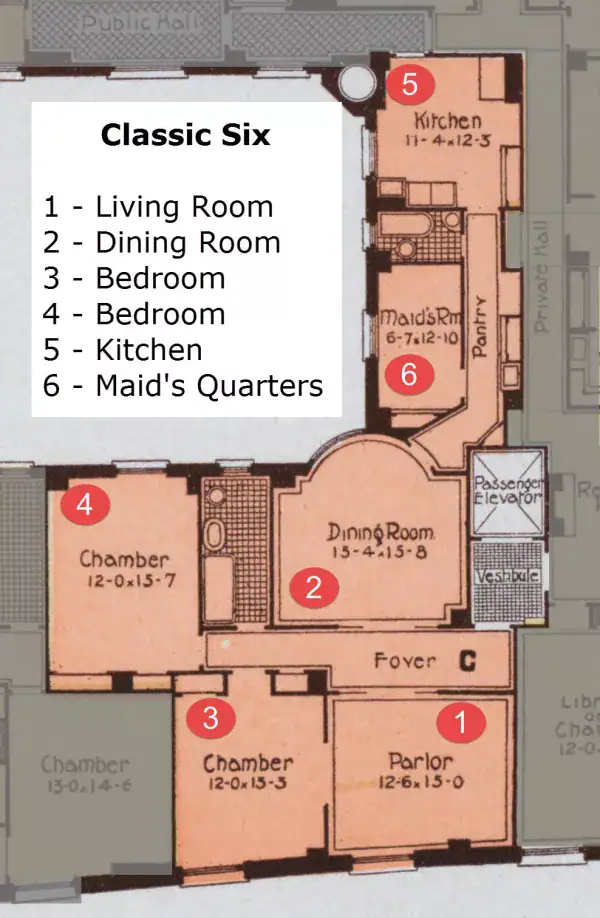
The pattern holds all the way up. Brick Underground’s broker confirms it: a classic five lacks the staff room, a classic seven adds a bedroom, and the rare classic eight adds one more small room on top. Nobody voted on this system. It just calcified.
The junior 4 is the one that causes arguments. The fourth room is often an alcove rather than a real room, and an alcove is not a bedroom however confidently the floor plan labels it.
The bedroom that isn’t one
Which brings us to the least romantic and most expensive fact on this page. A legal bedroom here needs at least 80 square feet, no dimension under 8 feet, and an 8 foot ceiling, in any multiple dwelling built after 18 April 1929. That’s NYC Admin Code 27-2074. It is also the line between a two bedroom price and a one bedroom price.
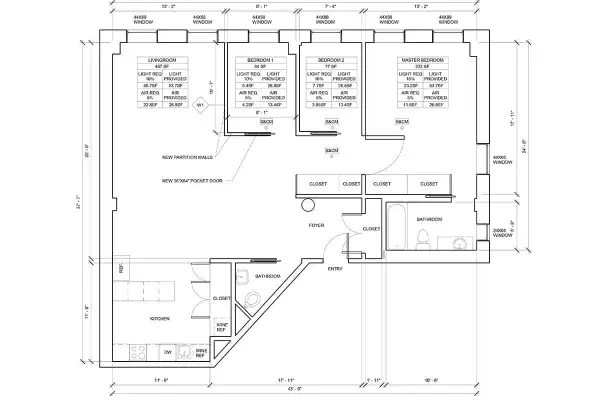
Note what that rule does not say. It doesn’t say 8 by 8. An 8 by 8 room is 64 square feet, which clears the minimum dimension and misses the minimum area by a fifth. We mention it because that arithmetic slip is everywhere, including, until recently, in one of our own posts.
It also doesn’t say anything about closets. No closet is required. Agents say otherwise with great confidence, and they’re wrong, and the code is free to read. Our full breakdown, including the exceptions for sloped ceilings and three bedroom apartments, is in what qualifies as a legal bedroom in NYC.
The features sold as if they were rooms
Some things on a listing aren’t rooms at all. They’re features, priced like rooms, and two of them come up so often they deserve their own warning label.
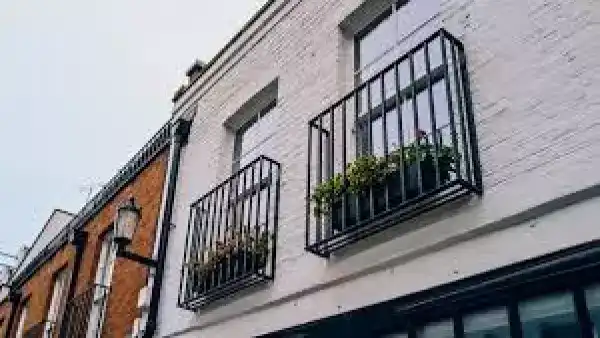
A Juliet balcony is a railing outside a door, somewhere between a few inches and a couple of feet deep. You can lean on it. You can’t put a chair on it, and you certainly can’t have anyone over.
Shakespeare is innocent here, incidentally. His stage direction reads “Enter Juliet above at a window”, and the word balcony appears nowhere in the play (Royal Shakespeare Company). Every balcony in every production since has been set design, and it has been selling real estate for four hundred years.
But it does filter into listing searches as outdoor space, and that’s the entire point. In a city where a real terrace is a luxury item, a railing that qualifies as outdoor space genuinely moves the price. Absurd, and true at the same time.
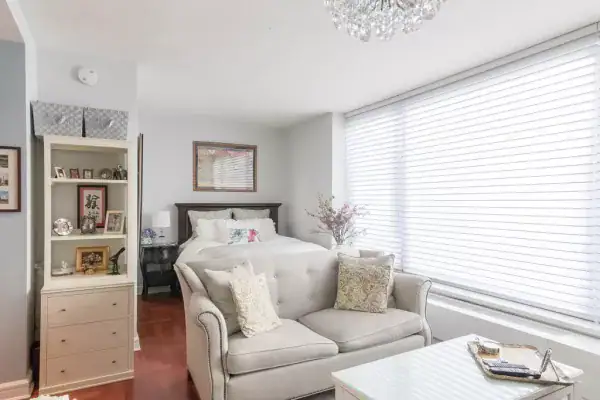
An alcove is the other one. The alcove in an alcove studio typically runs 40 to 48 square feet, so it’s a place to put a bed and not a bedroom. Fine, as long as you’re paying studio-plus rather than one-bedroom money.
The ones that aren’t apartments at all
We work in Westchester and Connecticut too, and the vocabulary changes the moment you leave the boroughs. Three terms turn up constantly, and none of them mean what a Manhattan buyer assumes.
| Term | What it is | Where the surprise is |
|---|---|---|
| Townhouse | A whole building you own, usually multi-storey, often with a rental unit in it | Different asset class from a co-op: different tax treatment, and the entire maintenance bill is yours |
| Patio home | A small single-family house in a managed development, built on a zero lot line | An association handles the lawn and the snow, and sends you the bill for it |
| FROG room | Finished room over garage | An acronym, not a wildlife situation. Usually the cheapest square footage in a suburban listing |
What we see in the field
Two patterns show up often enough to be worth naming.
The junior 4 marketed as a two bedroom is the most common gap between the listing and the tape measure. It’s not usually dishonest. There’s no legal definition of a junior 4, so a seller genuinely doesn’t know which way to list it. Bring a tape measure and the 80 square foot rule and you’ll know in thirty seconds.
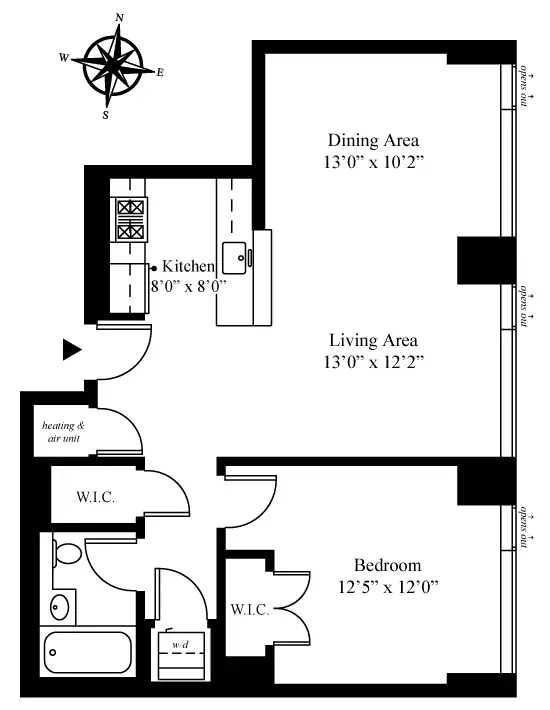
The alcove studio is quietly disappearing. Owners wall the alcove off and relist as a one bedroom wherever the room is big enough. That is exactly the arbitrage the 80 square foot rule governs. If the alcove clears it, that wall is the cheapest value you’ll ever add. If it doesn’t, the wall buys you a complaint.
NestApple buyers receive an average rebate of $22,000 on an average purchase of about $1.1 million. Since 2017, we’ve returned over $11 million to buyers.
On an apartment where the room count and the bedroom count disagree, that rebate is roughly what the correction is worth. How it works.
Common questions
Does a bedroom in NYC need a closet? No. There’s no closet requirement anywhere in the code. A legal bedroom needs the floor area, the minimum dimension, the ceiling height and a window. A closet is a nice-to-have that agents have promoted into a myth.
Is a junior 4 a two bedroom? Not unless the fourth room independently meets the legal bedroom rules, which it usually doesn’t. It’s a one bedroom with a flexible fourth room, and it’s priced between a one bedroom and a two bedroom for exactly that reason.
What’s the difference between an alcove studio and a junior 1? The alcove is open to the main room. A junior 1 typically has a separate room, even if that room has no window and therefore can’t be called a bedroom. Same idea, different amount of wall.
Why does the kitchen count as a room but the bathroom doesn’t? Because the convention was set in prewar buildings where the kitchen was a full, windowed, separate room and the bathroom was small and internal. The rooms that got counted were the ones people lived in.
Do classic sixes still get built? Not as such, but the layout has been revived. Brick Underground documents developers at 520 Park Avenue and 220 Central Park South reproducing the classic proportions in new condos. That tells you what the top of the market thinks of open plans.
Before you pay two bedroom money
Every layout on this page has a price attached to a word, and the word is frequently doing more work than the floor plan supports. Nobody’s lying to you. The vocabulary is just older than the rules, and it was never designed to be checked.
That’s a negotiation, not a disappointment, as long as you spot it before the offer instead of after the appraisal. The appraiser has a tape measure too, and less patience.
We represent buyers and hand back up to 2% of the purchase price at closing. On a typical New York deal that is the difference between a renovated kitchen and one you promise yourself you’ll get to. See how the buyer rebate works.

Nicole Fishman Benoliel co-founded NestApple in 2017. She's a lawyer admitted to the New York bar - her law degree is from La Escuela Libre de Derecho in Costa Rica, with further study at IE Business School in Madrid and an LLM from Fordham in New York. She does not act in a legal capacity at NestApple; every client is referred to an attorney who handles real estate deals full time.