What Is a Juliet Balcony?
Back to the NYC Real Estate Blog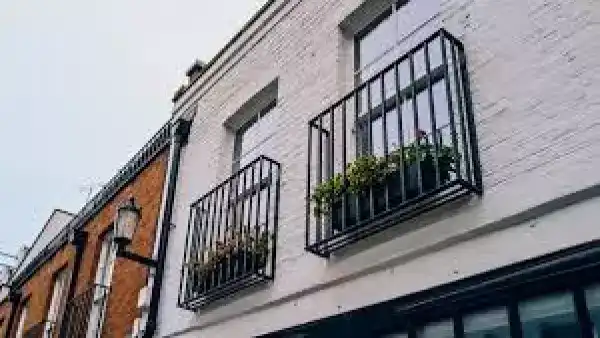
A Juliet balcony is a railing outside a door or full-height window, a few inches to two feet deep. You can lean on it. You cannot put a chair on it. In New York it counts as private outdoor space in listing filters: 58% of listings mentioning one carry that tag, against 31% overall.
We sell apartments with these constantly. The gap between what a Juliet balcony is and what it does for a listing is one of the odder things in this market.
Shakespeare didn’t write one
The name has been borrowed under false pretences for four hundred years. Shakespeare’s stage direction reads “Enter Juliet above at a window”, and the word balcony is nowhere in the play (Royal Shakespeare Company).
Fitting, because a Juliet balcony is set design too: it performs the idea of a balcony without providing one, and has been quietly adding to asking prices on that basis ever since. Also called a French balcony, or a balconet.
What it actually does
Three things, one of which is about going outside.
| What you get | |
|---|---|
| Light | Full-height glazing where a normal window would stop at the sill |
| Air | Doors that open completely, rather than a sash that opens halfway |
| Safety | Something has to stop the fall, and that depends on what opens |
| Space | None. This is the part people get wrong |
Russell Goss, a registered architect, puts it plainly: “a Juliet balcony isn’t actually a balcony. It’s simply a railing against inward-swinging French doors at the exterior of a building.”
Which safety rule applies depends on whether it’s a door or a window. The building code’s guard requirements, 42 inches high with no gap a 4-inch sphere passes, attach to a walking surface. A Juliet balcony isn’t one. For a French door, the railing does the work itself.
For a window, a different regime takes over. The NYC Health Code, chapter 12 names this exact case. A “balcony window” includes “an opening onto a balcony that does not have a walking surface” and excludes “a door opening onto a balcony”. Where a child of ten or under lives, that window needs a guard.
Worth knowing before anyone assumes the railing covers it.

What it does to a listing, and what it doesn’t do to a price
Here’s the mechanism, and it’s a good deal more mundane than four hundred years of romance would suggest.
StreetEasy has no balcony filter. It has one for private outdoor space, and “Balcony” sits underneath it as a feature the listing agent ticks. Tick it, and the apartment appears in a search that an identical apartment without it misses.
Measured on 27 August 2026: 31% of NYC sale listings carry the private-outdoor-space tag. Among those mentioning a Juliet balcony, 58% do.
That is visibility, not value. Some of those listings have a real terrace too, so the tag isn’t necessarily coming from the railing. And the standard method argues the other way: Jonathan Miller of Miller Samuel prices a square foot of outdoor space at “about 25 or 50 percent of the price per square foot for the apartment”. A Juliet balcony has approximately no square feet.
So it gets the apartment seen. Anyone naming a specific sum is guessing, ourselves included. What’s left is negotiable like any other soft feature, which is the argument for somebody pricing it who works for you.
Can you stand on one?
Sometimes, and it depends entirely on the depth. A balcony with a foot or two of floor will hold you, and people put a plant or a bicycle out there. A true balconet has no floor at all: the railing sits flush against the facade and the door opens onto air.
Ask which one it is before you assume. The listing photograph is always taken from inside, where the two are indistinguishable. That is not an accident. It’s a thirty-second question at a viewing, and the sort of thing somebody representing you asks without being prompted.
| The listing says | What to check |
|---|---|
| “Balcony” | Whether there is a floor. From inside, the photograph looks the same either way |
| “Private outdoor space” | Whether it is this railing or a real terrace somewhere else |
| “French doors” | Usually the honest version of the same feature |
What we see in the field
They’re far more common in prewar buildings than people expect. A lot of what looks like a design choice is an original guard that simply survived.
Nobody agrees what counts. One agent calls a twelve-inch ledge a Juliet balcony, another calls it a window guard, and the same apartment gets filtered into or out of a search depending on who typed the listing. Check the photograph, not the tag.
Adding one is possible, and narrow enough to be worth reading twice. It’s a facade alteration, so the board, the managing agent and usually the Department of Buildings all have a say. On a landmarked building the Landmarks rules name it specifically: a window opening may be lowered for “a new Juliette-style balcony”, but only on the top floor and only one opening.
So it’s not impossible. It is a project rather than a purchase, and if the balcony is why you want the apartment, buy the one that has it.
| What you want to change | Whose decision |
|---|---|
| Anything on the facade | The board, then the Department of Buildings |
| A wall inside the apartment | The board, usually with conditions |
| Furniture, screens, bookcases | Yours alone |
It’s the same question that governs a wall in an alcove studio and a converted fourth room in a junior 4. Anything touching the structure belongs to the building.
Common questions
Is a Juliet balcony the same as a French balcony? Yes. French balcony, Juliet balcony and balconet all describe the same arrangement.
Does a Juliet balcony add value? It gets the apartment in front of more buyers, through the outdoor-space filter and through the light. Anyone quoting you a percentage is guessing, and so would we be.
Can I put furniture on it? Almost never. A very deep one might take a single chair, and at that point it has stopped being a Juliet balcony.
Do they need maintenance? Less than a real balcony, since there’s no deck to waterproof. The railing is still the building’s responsibility to inspect, and in a prewar facade that inspection is not optional.
Light is the thing worth paying for
The best argument for a Juliet balcony isn’t the balcony. It’s that the room behind it has a door-height opening instead of a window, and on a dark New York street that changes how an apartment feels far more than two feet of floor would.
Whether it’s priced fairly into what you’re being asked to pay is a different question, and we answer it for every buyer we represent. See how the buyer rebate works, or the full guide to NYC apartment types.


Nicole Fishman Benoliel co-founded NestApple in 2017. She's a lawyer admitted to the New York bar - her law degree is from La Escuela Libre de Derecho in Costa Rica, with further study at IE Business School in Madrid and an LLM from Fordham in New York. She does not act in a legal capacity at NestApple; every client is referred to an attorney who handles real estate deals full time.