Largest Cities in Florida by Population
Go Back To Previous PageFlorida keeps growing, and not exactly quietly — it’s now the country’s third-most populous state and one of the fastest-growing, too. Beaches, no state income tax, and weather that keeps you on your toes during hurricane season: it’s not hard to see why. Here are the 11 largest cities in the state by population, using current Census Bureau estimates rather than figures from a few Census cycles ago.
Retirees have been coming here for decades, but lately it’s just as much a working-age migration — no state income tax, a lower cost of living, mild winters, and roughly 825 miles of coastline across the peninsula and panhandle will do that.
Quick Answer: Is Miami Florida’s Largest City?
No — despite being Florida’s most recognizable name internationally, Miami isn’t even close to the largest city by population. That title belongs to Jacksonville, which has more than double Miami’s population. This confusion is understandable: Miami anchors a much larger metro area, and its skyline gets far more screen time than Jacksonville’s.
| Rank | City | Population | Data As Of |
|---|---|---|---|
| 1 | Jacksonville | 1,009,833 | 2024 |
| 2 | Miami | 487,014 | 2024 |
| 3 | Tampa | 414,547 | 2024 |
| 4 | Orlando | 334,854 | 2024 |
| 5 | St. Petersburg | 267,102 | 2024 |
| 6 | Port St. Lucie | 258,575 | 2024 |
| 7 | Hialeah | 235,388 | 2024 |
| 8 | Cape Coral | 233,025 | 2024 |
| 9 | Tallahassee | ~204,000 | 2024, estimate |
| 10 | Fort Lauderdale | 190,641 | 2024 |
| 11 | Pembroke Pines | ~175,000 | 2024, estimate |
Source: U.S. Census Bureau population estimates (Vintage 2024), via multiple cross-checked citations. Tallahassee and Pembroke Pines figures are estimates pending direct confirmation from census.gov.
This is a real reordering from older lists still floating around: Port St. Lucie has now overtaken both Hialeah and Cape Coral, driven by one of the most sustained growth runs of any city in the country (more on that below).
1. Jacksonville (Population: 1,009,833)
Jacksonville is Florida’s largest city by population and by land area — at 747 square miles, it’s one of the biggest cities in the country geographically, not just in Florida. There’s a specific reason for that: in 1968, Jacksonville consolidated with Duval County, merging the city and county governments and absorbing nearly the entire county into the city limits.
That single decision is the main reason it dwarfs every other Florida city on this list — it’s not that Jacksonville organically outgrew Miami or Tampa so much as its municipal boundary happens to be enormous.
It has the museums, the zoo, the shopping, and the shoreline to match its size, without quite the tourist crush of Miami or Orlando.
2. Miami (Population: 487,014)
Miami is the state’s second-largest city and its most recognizable export — Cuban food, Art Deco architecture, and a subtropical climate that makes “hot and humid” a year-round personality trait. Ocean Drive and South Beach get the postcards, but Miami is also a legitimate finance and commerce hub, not just a backdrop for spring break.
3. Tampa (Population: 414,547)
Tampa anchors the Tampa Bay area,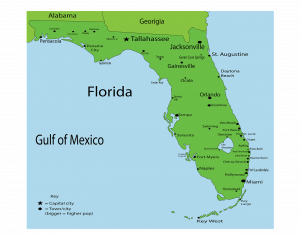 with a downtown that’s grown well past its reputation as “the other Florida city.” The Tampa Museum of Art, the Florida Aquarium, and the Riverwalk along the Hillsborough River give it a genuinely walkable core — a rarer thing in Florida than you’d expect.
4. Orlando (Population: 334,854)
Orlando’s resident population is a rounding error compared to the tens of millions who pass through every year for Walt Disney World, Universal Studios, and SeaWorld — by visitor volume, Orlando isn’t just Florida’s busiest city; it’s one of the most-visited cities on Earth, population ranking be damned.
But there’s an actual city underneath the theme parks — lakes, green space, a real arts scene at the Orlando Science Center, and the Kennedy Space Center Visitor Complex a short drive away for anyone who’s had enough of mouse ears.
5. St. Petersburg (Population: 267,102)
St. Petersburg, on the Gulf side of Tampa Bay, has quietly built one of the more interesting arts scenes in the state — the Salvador Dalí Museum holds the largest collection of his work outside Spain. Notably, St. Petersburg is the only Florida city on this list to actually lose population recently rather than grow — a modest dip between 2024 and 2025, in a state where nearly everywhere else is expanding.
6. Port St. Lucie (Population: 258,575)
Port St. Lucie, roughly halfway between Orlando and Miami on the east coast, is the growth story on this entire list. As of the Census Bureau’s most recent (2025) estimate, it’s grown to roughly 268,062 residents — and it has now spent five consecutive years as the fastest-growing large city in the entire United States, not just Florida. At that pace, it may have already caught up to or passed St. Petersburg for the #5 spot by the time you’re reading this.
7. Hialeah (Population: 235,388)
Hialeah, just northwest of Miami, has one of the strongest Cuban-American cultural identities of any city on this list — you can taste it before you see it. Hialeah Park Race Track still runs live horse racing plus a casino, and the Leah Arts District gives the city a genuine creative scene, not just a commuter-suburb reputation.
8. Cape Coral (Population: 233,025)
Cape Coral, on Florida’s southwestern coast, has more canal frontage than almost anywhere else in the country — the city is laced with waterways, most of them lined with homes that back straight onto the Gulf of Mexico. Add in parks, golf courses, and a population that’s grown steadily, and it’s less a sleepy retirement town than its reputation suggests.
9. Tallahassee (Population: ~204,000)
Tallahassee is Florida’s capital, tucked into the panhandle with a population that skews notably younger than most of the state, thanks to Florida State University and Florida A&M University. Between the state government, two major universities, and a legitimate arts, theater, and music scene, Tallahassee runs on a different energy than the beach-town cities further south.
10. Fort Lauderdale (Population: 190,641)
Fort Lauderdale, just north of Miami, has earned the nickname “Venice of America” for its extensive network of canals and waterways, including the Intracoastal Waterway and the New River — good enough that plenty of residents commute by boat instead of car. Add 20 miles of beach, and it’s easy to see why people who love the water end up staying.
11. Pembroke Pines (Population: ~175,000)
Pembroke Pines rounds out the list, with a reputation built more on award-winning schools and family-friendliness than on any single tourist landmark. It’s the kind of city that consistently ranks well without ever making the postcards — local and national retailers, luxury homes, and more affordable apartments in nearby neighborhoods are all within easy reach.
A Note on the Numbers
Population figures for the same Florida city can vary by 20,000 to 55,000 people or more depending on which source and which year you check — different sites blend Census Bureau annual population estimates, slower-moving 5-year American Community Survey averages, and their own growth projections, often without saying which.
The figures above are Vintage 2024 Census Bureau estimates, wherever available, cross-checked across multiple independent citations, with Tallahassee and Pembroke Pines flagged as estimates since a single authoritative figure wasn’t confirmable at publish time. If you need an exact, current figure for a specific city, the Census Bureau’s own QuickFacts pages are the most reliable primary source. For similar breakdowns elsewhere, see our guides to the largest cities in Nebraska and the largest cities in Ohio.
FAQ
Is Miami the biggest city in Florida?
No. Jacksonville is Florida’s largest city by a wide margin (over 1 million residents vs. Miami’s roughly 487,000), mostly because Jacksonville’s city limits absorbed almost all of Duval County in a 1968 consolidation. Miami is better known internationally, but it’s the state’s second-largest city, not the largest.
What is the fastest-growing city in Florida?
Port St. Lucie. It’s grown fast enough, for long enough, that the Census Bureau has named it the fastest-growing large city in the entire United States for five consecutive years running — not just in Florida.
What is the busiest city in Florida?
By resident population, Jacksonville. By annual visitor traffic, it’s not close — Orlando, despite ranking 4th in population, draws tens of millions of tourists a year for its theme parks, making it one of the most-visited cities in the world.
Why is Jacksonville so much bigger than other Florida cities?
Mostly municipal geography, not organic growth alone. Jacksonville’s 1968 city-county consolidation with Duval County means its official city limits cover nearly 750 square miles—far larger than the tightly bounded limits of Miami, Tampa, or Orlando.



Georges has been working in Wall Street for the last 16 years trading derivatives with hedge funds. He has been an active real estate investor for over a decade. Georges graduated from HEC Business School in Paris and holds a master in Finance from ESADE Barcelona.