Largest Cities in Nebraska
Go Back To Previous PageNebraska is the 16th-largest state by land area but only the 37th most populous — about 1.9 million people spread across a lot of open space, making it the 7th least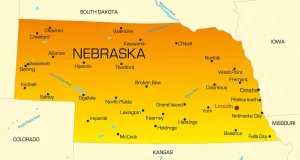 densely populated state in the country. What it lacks in big cities, it makes up for with a long list of small, friendly towns that take Midwestern hospitality seriously.
Below is a list of the ten largest cities in Nebraska by population, using current Census Bureau estimates.
10 Largest Cities in Nebraska
- Omaha
- Lincoln
- Bellevue
- Grand Island
- Kearney
- Fremont
- Norfolk
- Hastings
- Columbus
- Papillion
Omaha, Nebraska (Population: ~488,500)
Omaha isn’t just Nebraska’s largest city — it’s so much larger than the rest of this list that comparing it to them feels a little unfair. At roughly 488,500 residents, it’s just outside the top 40 largest U.S. cities (currently around 41st, per the latest Census Bureau estimates), and the anchor of a metro area spanning eight counties across two states. The Omaha-Council Bluffs metro area recently crossed the 1 million mark for the first time, making it roughly the 55th-largest metro in the country.
Low cost of living, a strong economy, and ample outdoor space have made it a consistent pick for best places to raise a family — and the population grew 18.9% between 2010 and 2020, with steady, more modest growth continuing since.
Lincoln (Population: ~296,000)
Lincoln, Nebraska’s second-largest city at roughly 296,000 residents, anchors the Lincoln-Beatrice Metropolitan Statistical Area.
Good schools, a genuinely friendly community, and no shortage of parks have made it popular with families and young professionals alike — about 20% of residents are in their 20s, and the median age (33.9) runs a full 10% below the state average. Population grew 12.7% between 2010 and 2020, and has continued to grow at a steady clip since.
Bellevue (Population: ~64,700)
Bellevue, in Sarpy County, just 8 miles south of downtown Omaha, blends suburban comfort with real urban amenities despite being far smaller than its neighbors — roughly 64,700 residents and counting.
Its proximity to Offutt Air Force Base brings in a steady stream of military families, and the population jumped 28% between 2010 and 2020, among the fastest growth rates on this list.
Grand Island (Population: ~53,500)
Grand Island, the state’s fourth-largest city at roughly 53,500 residents (recent estimates put it as essentially flat, with different sources showing very slight growth or decline), anchors a four-county metro area (Hall, Merrick, Howard, and Hamilton). It’s home to the Nebraska Law Enforcement Training Center and the Southern Power District.
It backs that up with low crime, an affordable cost of living, and a stable economy — a solid combination for anyone chasing small-town life without giving up job opportunities.
Kearney (Population: ~34,500)
Kearney sits in Buffalo County right along Interstate 80, putting it within easy reach of Omaha, Denver, Kansas City, Des Moines, Wichita, and Cheyenne — genuinely central to a seven-state Midwestern region of over 20 million people.
The University of Nebraska at Kearney keeps the population young (47% are under 30), and steady growth since the 1940s, when the city had under 10,000 residents, has continued into the 2020s.
Fremont (Population: ~27,800)
Fremont, the seat of Dodge County, sits along the Platte River about 35 miles from Omaha and 50 from Lincoln — close enough that it functions as a bedroom community for Omaha commuters.
Growth has remained modest but positive, and the city leans heavily toward family-friendliness: 27% of residents are under 20, and married couples make up 61% of households.
Norfolk (Population: ~26,400)
Norfolk, at the intersection of US Routes 81 and 275, is the biggest mover on this list — strong recent growth has pushed it past both Hastings and Papillion into the #7 spot, a jump from where it ranked just a few years ago.
It remains a quiet, family-oriented city with plenty of breathing room and anchors its own micropolitan area of about 50,000 people.
Hastings (Population: ~25,100)
Hastings anchors the Hastings micropolitan statistical area across Adams and Clay counties, with growth that’s essentially flattened out in recent years. It also happens to be the birthplace of Kool-Aid — a low-key claim to fame for a safe, affordable city with a spacious suburban feel.
An early-20th-century growth spurt left behind a solid stock of Craftsman, Colonial Revival, and American Foursquare homes. Hastings, Columbus, and Papillion are now close enough in population that different data sources don’t fully agree on their exact order.
Columbus (Population: ~25,300)
Columbus, the county seat of Platte County, sits roughly 85 miles from Omaha and 76 from Lincoln. Its economy runs on farming and manufacturing, and the atmosphere stays quiet and friendly, with growth continuing at a modest, steady pace.
Papillion (Population: ~25,100)
Papillion, a Sarpy County suburb in the Omaha metro, was one of the state’s fastest-growing cities over the 2010s, up 27.9% between 2010 and 2020, and continues growing steadily today.
It’s notably affluent — a median household income of $104,608, about 50% above the state average — and was ranked by Money Magazine as the second-best place to live in the entire country. Not bad for a place most people outside Nebraska have never heard of.
For similar breakdowns elsewhere, see our guides to the largest cities in Florida and the largest cities in Ohio.



Georges has been working in Wall Street for the last 16 years trading derivatives with hedge funds. He has been an active real estate investor for over a decade. Georges graduated from HEC Business School in Paris and holds a master in Finance from ESADE Barcelona.